

Scotland Trip:
Leg 1-2: Dungarvan- Dunmore East- Kilmore Quay- Dun Laoghaire (126nm)
It seems to be a bit of a tradition that I get unfavourable weather at the beginning of a sailing voyage, and this time it seemed to be no different. Having had a fair weather sail the previous Sunday from Dungarvan to Dunmore East, I had been hoping for more of the same. Sipadan had been alongside the pontoon in Dunmore East for the week, and I had managed to take out the paddle board to make the most of the beautiful weather exploring the coves of Dunmore after work on 2 occasions. Looking at the three day weather forecast, things were not looking very favourable, with 24kn sustained gusting 28-30 predicted on the Saturday and Sunday, right when I was planning on getting her north to Howth via an overnight in Arklow on the Saturday.
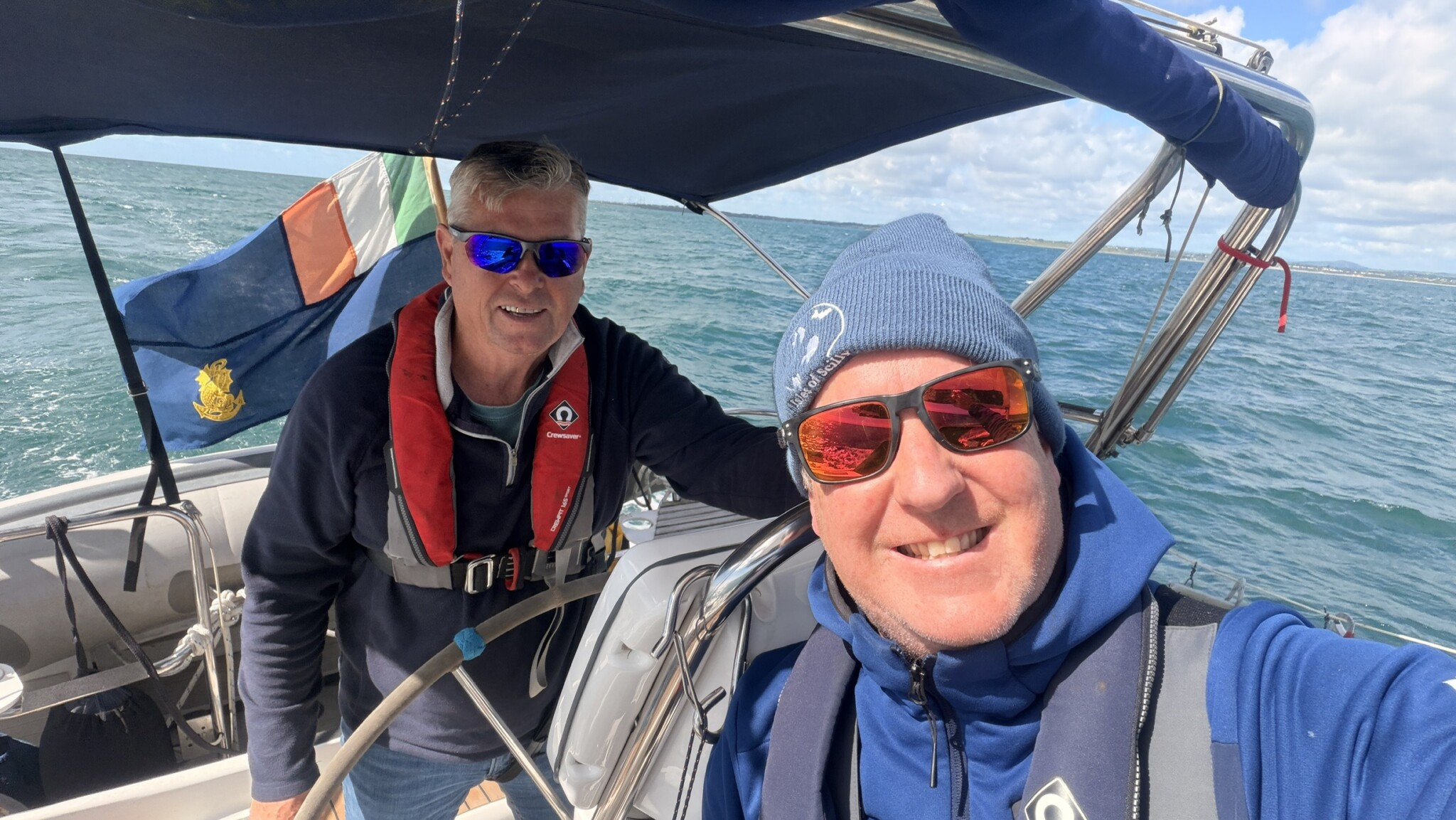
I had hardy crew in the personage of Hugh Foley, with plenty of offshore sea miles under his belt, or under his keel depending on which metaphor you wished to use. We decided to keep a weather eye and play it by ear. Fortunately it was a good weekend to be in Dunmore East with The Stunning playing the Haven Hotel as part of “Havenfest”. There was a great atmosphere for the gig, though the torrential rain did put a slight damper on the gig, with some of the younger, less stalwart fans bailing out when the rain came. I was more concerned with the forecast for the following day, obsessively updating windy.com to get the latest.
The following morning we went down to the pontoon at 6.30am to assess the conditions. The forecast had moderated somewhat, though it was showing some 30kn gusts later in the day, though this should be when we were around Carnsore Point and on a broad reach heading up the Irish Sea, and coming from the land, the swell should not be too extreme. The trick would be getting around Hook Head, as the wind would be coming from the SSW and therefore this would mean beating into strong winds, or simply motoring upwind to get around. The more immediate problem would be getting off the dock. The evening before, in anticipation of an early start, I had moved Sipadan outside the 2 motor cruisers, that seemed to be occupying a semipermanent position on the pontoon. The direction of the wind would be blowing us directly against the boat alongside, and the trick would be getting off safely.
We decided to spring off, which took some doing with strong gusts and eddies blasting through the harbour. Underway, we raised the mainsail (with 2 reefs) in the lee of the harbour to avoid going on deck in the swell. Leaving the shelter of the harbour we initially had 35kn sustained, though once away from the channelling effect of the headland this moderated to 24kn. We wanted to keep as far away as possible from the Hook, as with the tide falling and the wind from the south there were likely to be some nasty overfalls. Motoring upwind, we settled into an uneasy rhythm, on constant alert. Off Hook Head, things turned out to be nastier than forecast and Sipadan’s wind meter recorded a peak gust of 43.9kn (a record for Sipadan at force 9). At one stage a wave lifted her and laid her on her side, though she recovered quickly.
The really hairy moment was just off the Hook, when a lobster pot buoy suddenly appeared over a wave crest and disappeared under the keel. I immediately put her into neutral and waited an agonising second to watch, with relief, the buoy pop back up from under the rudder. This could have been very nasty and it was probably time to either head back, or duck into Kilmore Quay and wait out the weather. At this point we decided Kilmore was the best bet and I dialled the number for the harbourmaster, to enquire about a berth. “Is that you off the head?” he enquired (he had obviously been tracking us on Marine Traffic). When I said yes, indeed it was, he replied, “I was expecting your call.” There is comedy in the most serious situations.
Ducking into Kilmore we picked up our berth and gathered ourselves to plan our next steps. Our initial plan was to leave at 8pm, when the weather would, at least in part, have moderated. However, this would put us against the tidal currents at Carnsore and the Irish Sea, with a dangerous wind against tide situation, and after our experience at the Hook, I had no desire for a repeat performance. This was not my first time weather-bound at Kilmore, and indeed I had begun to associate Kilmore with a sort of heavy weather purgatory. The previous time I had sailed there with Su Yin and the kids, we had arrived to find everything closed for a funeral and then spent the next 2 days weather-bound, at which time my crew had bailed and I ended up solo sailing out of there in horrible weather.
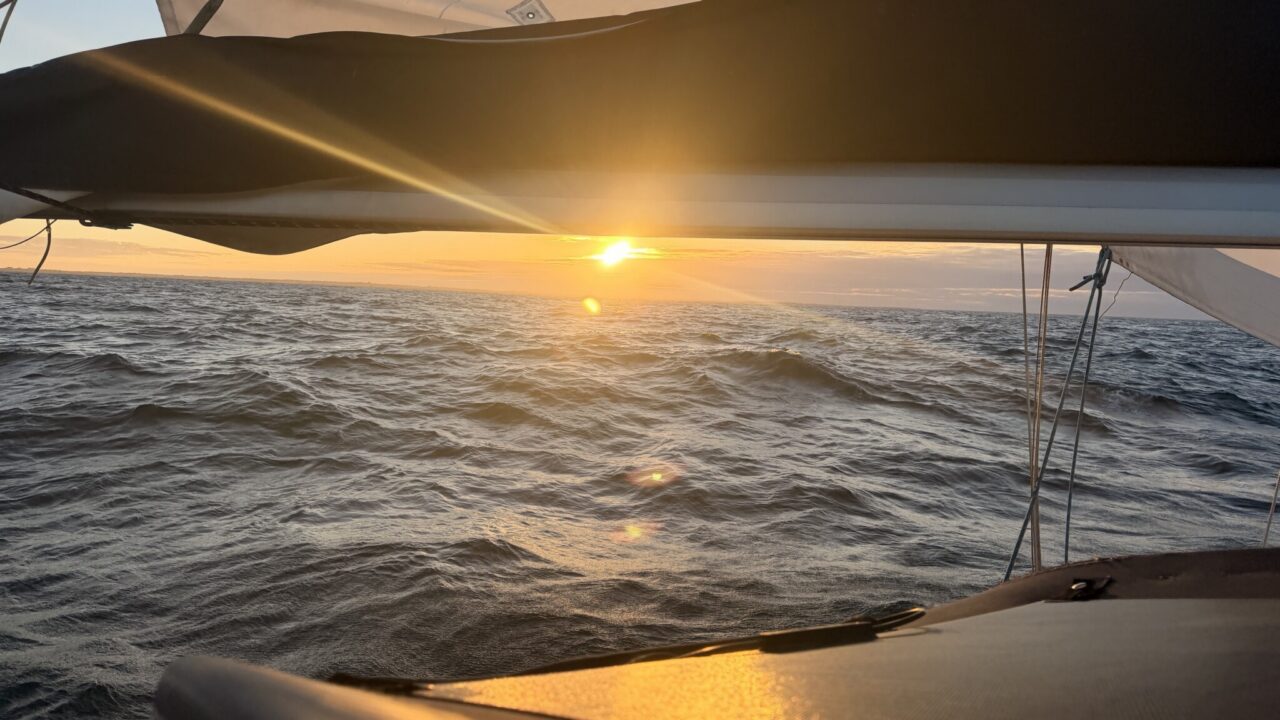
That being said, it is a friendly harbour and the harbourmaster was helpful. We wandered into the village and had a hearty lunch in Keogh’s, followed by a snooze and then a minibus to Mary Barry’s for more food! Looking at the tides and weather it seemed that 2am would be optimal for departure, but the harbourmaster dissuaded me, telling me that there was 20,000 lobster pots between Kilmore and Carnsore. I think this may have been an exaggeration, and in fact, though we waited until 4.30am to avail of the morning light, we did not see even one lobster pot. We did have a glorious sunrise off Carnsore Point, made all the more beautiful by the terrifying swell coming from the south.
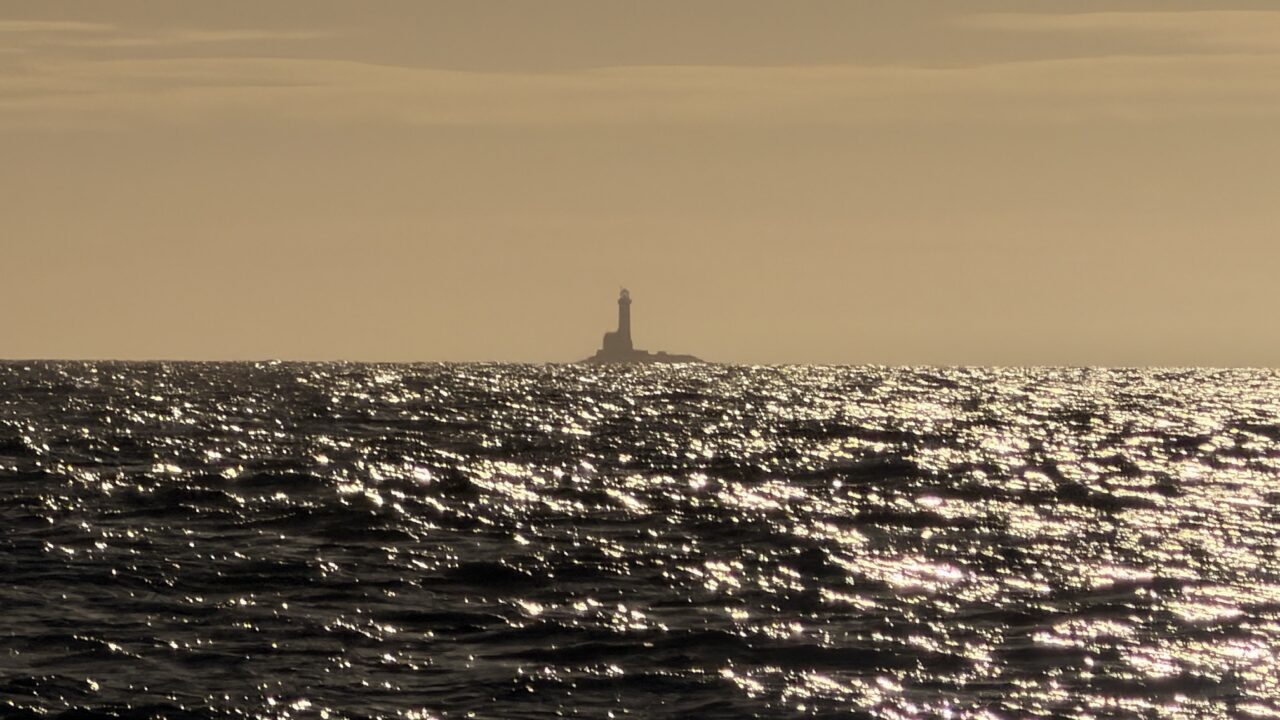
It was with considerable relief that we rounded the point, possibly the most boring promontory in Ireland, though it is enhanced by the romantic beauty of the Tuskar Rock lighthouse twinkling offshore in the dawn light. The wind was now in a favourable position off our starboard quarter and the swell lessened as we went up the Irish Sea and the land began to shelter us. The passage up the coast was uneventful, from a sailing point of view though the wind did not drop below force 6 for the duration. I did have to do some en route engine repairs, when I got a temperature alert on my engine panel off Arklow. Going through the checklist, she was pumping raw water, the oil an coolant levels were ok and the belts were the correct tension, what was the problem? I decided to swap out the impellor anyway, though it seemed fine. It might have been more clever on my part to close the saildrive seacock before opening the impeller plate, leading to a bit of a scramble to get cushions up to get at it as the boat took on water. Momentary panic over, in the end, the root of the problem, was the O ring for the plate covering the raw water pump. It was not properly in its groove (my fault) leading to inadequate suction, such that, the pump was pumping, but not enough. Problem solved, I mused that there must be no individual part of a sailboat that I had not been introduced to at some stage. There were a surprising amount of offshore hazards along the east coast of Ireland with lots of shallow reefs. There were some nasty overfalls off Wicklow Head, again due to wind against tide, but we soon found ourselves crossing Killiney Bay with all sails up. I eyed Dalkey Island Sound, thinking how cool it would be to fly through there, all sails set.
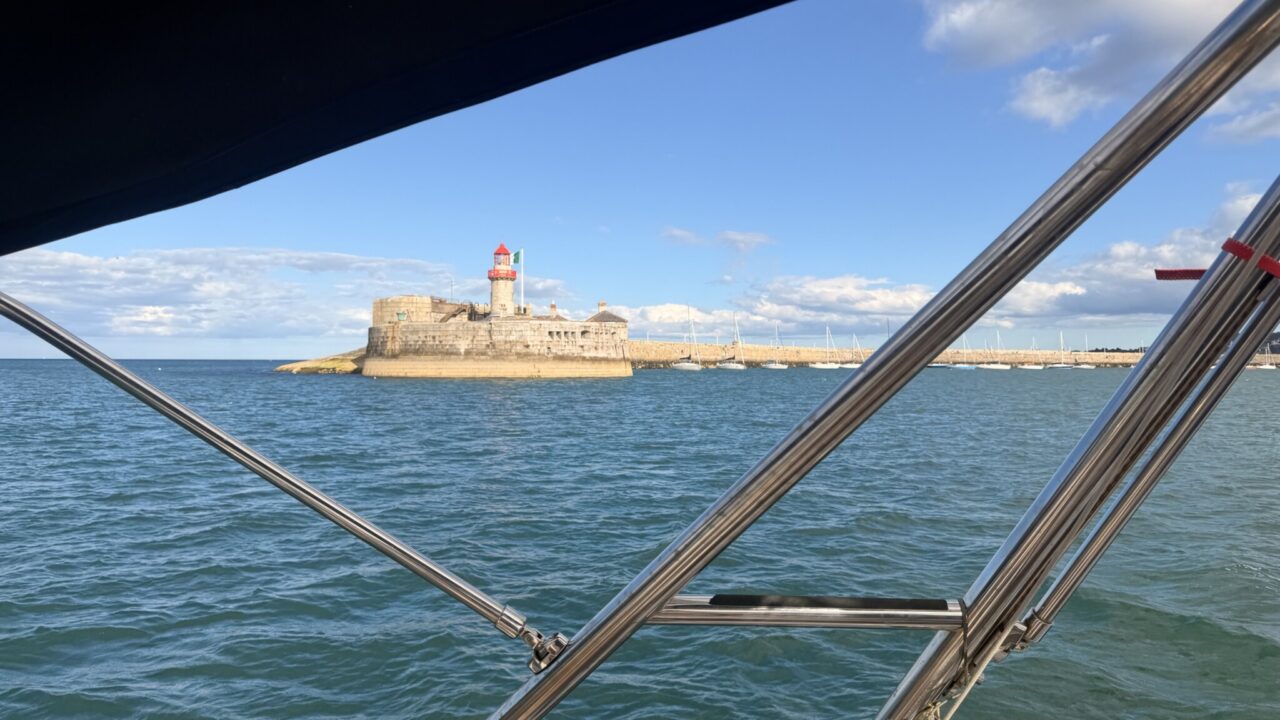
The weather soon humbled me, with 30-40 knot katabatic winds coming down from the Wicklow Mountains right in front of Bono’s house on the Vico Road, nearly knocking me flat. A quick frantic winching in of headsail and dropping of mainsail later, I came through the sound much more humble, with sails down and fenders and lines ready for Dun Laoghaire Marina we had changed ou. We had decided not to press on to Howth. We had a tricky approach, but managed to get alongside, and when we got in we discovered that there was a French fleet of 3 classic William Fife yachts, sheltering from heavy weather and waiting for an opportunity to head south to France. Sipadan had again done herself proud and kept us safe on what was an exhilarating passage. Kilmore Quay to Dun Laoghaire, an 85 mile passage, had been done in 14 hours for an average speed under sail of 6 knots. We were back on track for Scotland the following week.